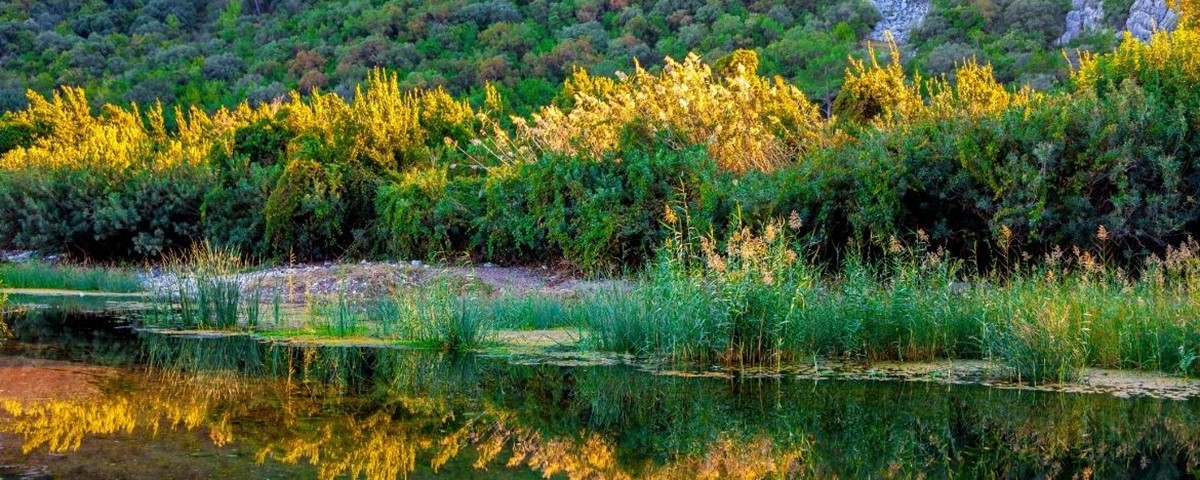
Antalya, located in the south of Anatolia between the Taurus Mountains and the Mediterranean, owes its rich plant diversity and natural beauty to the long geological processes it has experienced and its fortunate geographical position. Following all the tectonic shifts and depressions in the region, plant forms that moved downward during the glacial period created a rich habitat for flora in Antalya and its surroundings.
As is well known, the vegetation of the Mediterranean region is primarily maquis. But what does maquis vegetation mean? Maquis is defined as dense shrubland that does not exceed 3 to 5 meters in height. This vegetation dominates up to approximately 600 meters above sea level, remaining green during winter and resistant to hot and dry summers. Examples of plants in maquis vegetation include sandalwood, oleander, wild strawberry, kocayemiş (Arbutus), and wild olive.
As the altitude increases from sea level, mixed forests known as slope forests emerge. Up to around 1,200 meters, these forests consist of oak and red pine trees, with species such as black pine and Aleppo pine also present. Above 1,200 meters, high mountain forests appear, dominated by beech, yellow pine, fir trees, and junipers, with cedar trees frequently found in the Western Taurus region. These forests continue up to 2,000 meters, becoming sparser and shorter in height, eventually ending at around 2,300 meters. Beyond this level, alpine meadows or mountain pastures begin, consisting of colorful flowering grasses.
Overall, Antalya’s forests, which cover roughly 950,000 hectares, host a variety of species including thistle, mastic tree, plane tree, heather, and spruce, alongside unique flowers and herbs such as Tokuz, Çakır thistle, chrysanthemum, asparagus, and carob. Additionally, olive trees, considered a natural wonder, are widespread throughout Antalya.
Endemic Plant Species in Antalya
After recalling Antalya’s general vegetation and characteristics, let’s now take a closer look at its endemic plant species. First, it is useful to understand the meaning of the term “endemic,” frequently discussed in ecological contexts today. Derived from the Greek word “Endemos,” endemic means “belonging to that place.” Therefore, an endemic plant is one that does not grow outside its native area. In other words, endemic species are specialized to their specific regions.
According to studies, Antalya has around 840 endemic plant species when subspecies are included. This number exceeds the total endemic species in Spain and accounts for more than 20% of Europe’s total plant species. These figures highlight Antalya’s value and the importance of protecting its endemic flora, alongside its general vegetation diversity. Valuable studies on this topic have been conducted by organizations such as ATAV and ANTOK.
In comparison, Turkey as a whole has over 9,100 plant species, with roughly 3,300 being endemic. Considering Europe’s total of around 4,000–4,500 endemic species, it is clear that Turkey is a geographically valuable region for endemic plants. Of these 3,300 endemic species, approximately 600–650 are found in the Mediterranean region, around 500 of which are within Antalya province, with 200 species exclusive to Antalya itself. (The 840 species figure mentioned earlier includes subspecies.) After Antalya, provinces rich in endemic species include Konya, Mersin, and Kayseri.
Studies on Endemic Plant Species in Antalya
Endemic plant species are highly significant for Antalya. To highlight this value and promote sustainability, civil society organizations have carried out several projects in the region.
ANTOK – “Beşi Bir Yerde” Project
ANTOK, the Antalya Association for the Protection of Orchids and Biodiversity, plays a vital role in preserving Antalya’s endemic species. Through its “Beşi Bir Yerde” (“Five in One Place”) project, ANTOK protected five species at risk of extinction. The study highlighted that 44 endemic plant species in Antalya faced such risks. The project was carried out by Prof. Dr. İsmail Gökhan Deniz, Assoc. Prof. Candan Aykurt, bioengineer Hüseyin Çağlar İnce, and forest engineers Mehmet Ali Başaran and Ahmet Kısa. The initiative was supported by ANTOK, Antalya Forest Regional Directorate, Akdeniz University Botanical Garden Research and Application Center, and WWF Turkey’s Canı Hibe program.
The five species protected are: the Kemer Orchid, Olympos Saffron, Side Monster Plant, Kaputaş Andızotu, and Kangay. Notably, the Side Monster Plant is found only in the dunes of the ancient city of Side and the Sorgun dunes.
ATAV Endemic Plant Exhibition
In 2016, during EXPO 2016 in Antalya, the Antalya Promotion Foundation (ATAV), with the support of ICF Airports, organized an exhibition at Antalya International Airport showcasing the province’s endemic plant species. The exhibition highlighted rare plants, such as the endemic sand lily found only in Lara. It also explained the origins of the plants’ names. In this context, ATAV’s president, Nizamettin Şen, emphasized: “Endemic plants, like all natural riches, play an important role in promoting a region. They do this exceptionally well because many endemic plants bear names derived from the country’s history, such as Anatolica, Anatolicum, or Turcicum.”
07.07.2021