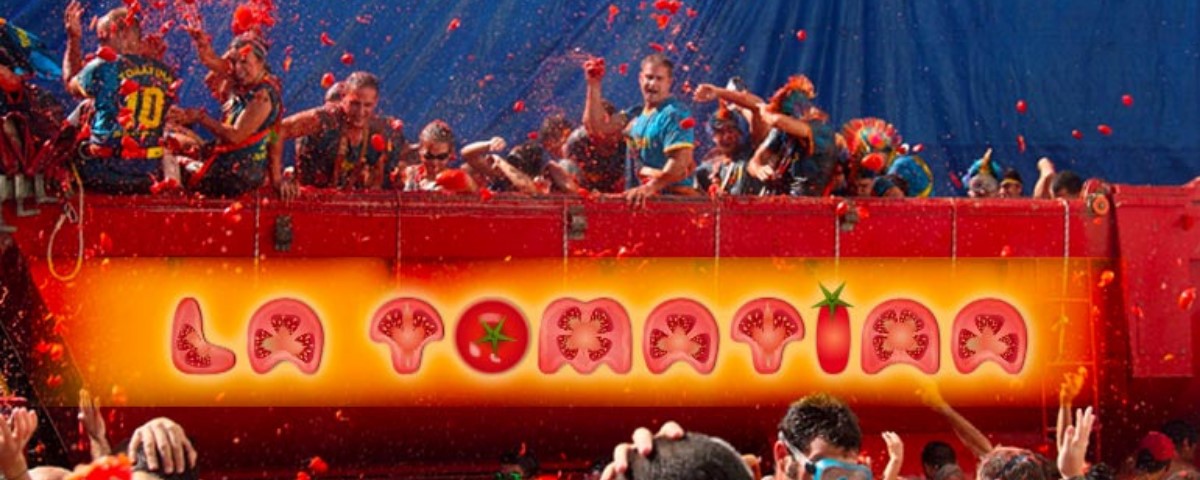
Spain also attracts attention with a now traditional tomato festival in addition to its magnificent cities, delicious food, and various traditional activities such as bullfighting. Called La Tomatina in Spanish, this festival takes place on the east coast of the country, in the narrow streets of the medieval city of Buñol. The festival starts on the last Wednesday of August every year since 1945. The week-long festival includes cooking competitions, parades, open-air parties, and fireworks shows. However, the most popular and famous part of the festival is the one-hour tomato battle with 140 tons of tomatoes, attended by an average of 22,000 people.
The history of the traditional Tomato Festival is a bit complicated, but it is said to have started in 1944 or 1945. In those years, a parade was organized to commemorate St. Luis Bertran, one of the most important historical figures of the city. During the parade, a group of young people in the area knocked the head part of the costume of one of the artists on the parade to the ground and the whole crowd got into a huge fight that continued until the police calmed things down. The fight broke out when the brawlers grabbed tomatoes from a nearby tomato stall and threw them at each other, laying the foundations for the current tomato festival. Some groups of young people are already planning such a tomato fight for the same parade next year. They even bring their own tomatoes. Although they are prevented from doing so by law enforcement, the annual tradition has begun and thousands of people follow in their footsteps in the years that follow.
Due to its lack of religious significance, the Spanish Tomato Festival was banned by Francisco Franco in the early 1950s. Despite the ban, participants who tried to hold the festival were arrested, but people protested and the festival was reinstated. The festival was then banned again until 1957. This time the people protested by carrying a huge tomato in a coffin, followed by a funeral procession playing funeral music. Eventually, La Tomatina is allowed to take place and becomes an official festival. After being mentioned in a news program called Informe Semanal, the La Tomatina festival becomes known throughout the country. Each year the number of participants grows exponentially. In 2002 it was officially declared an International Tourist Festival, attracting visitors from as far away as Japan and Australia. In 2013, the city council introduced a system that limits attendance to 22,000 people.
The Tomato Festival celebrations start quite early. Many people arrive in Buñol early, taking trains and buses from the Valencia region. By 10 am everyone is gathered in the town's main square, the Plaza del Pueblo. Here a small ritual takes place before the tomato battle. People climb a soapy pole with meat tied to the top and try to bring it down. After that, the tomato fight begins at 11 am, when the big trucks carrying the tomatoes arrive. Participants stick to the start and finish whistle, throwing overripe tomatoes at each other over the course of an hour. The administrators have set some rules to prevent harm to the participants, as follows:
• Not throwing anything other than tomatoes
• Crushing tomatoes before throwing
• Keeping a certain distance from trucks
• Stopping as soon as the end whistle sounds
• Not targeting buildings directly
As long as all these rules are followed, participants have a safe and fun time. Once the tomato war is over, some participants go to the Los Peñones pool to clean up, while others use hoses provided by local people to cleanse their bodies of tomato residue. In about an hour, the fire brigade washes the roads and restores the city to its former state. In the afternoon, participants continue the celebrations with live music and dance shows, and sangria, a traditional Spanish cocktail.
15.09.2023