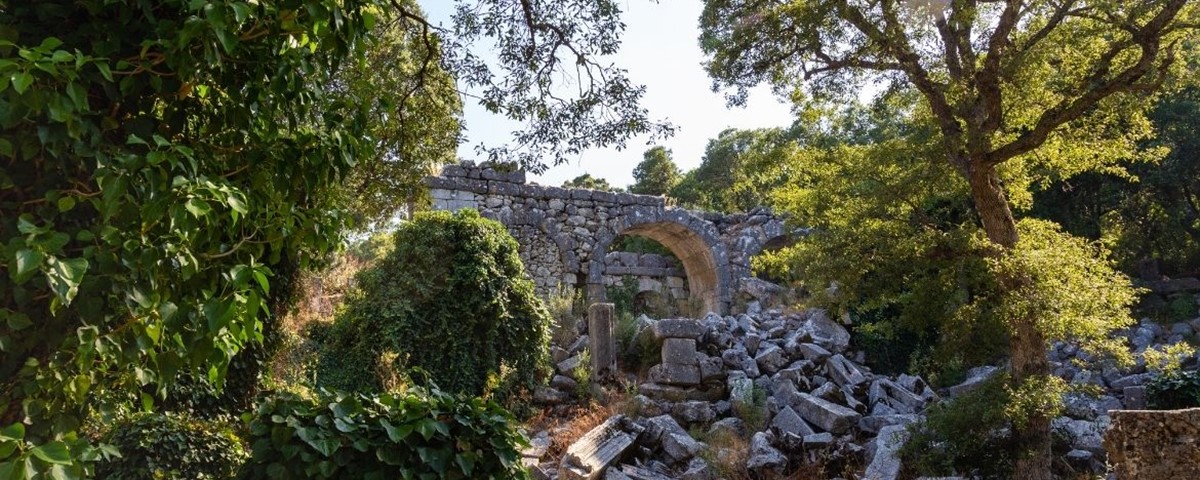
Hidden among the mountains of Antalya and long known throughout history as the “Eagle’s Nest,” the ancient city of Termessos offers both the grandeur of the past and the untouched beauty of nature. Built upon the steep cliffs of the Taurus Mountains, Termessos captivates visitors not only with its archaeological remains but also with its enduring spirit of freedom. This is the ancient city that even Alexander the Great could not conquer. Today, its silence, the magnificence of its theater with panoramic views, and its forested atmosphere make Termessos a unique meeting point of history and nature.
The History of Termessos
The origins of Termessos stretch directly into mythology. Its founders are believed to have been the Solymi, a people mentioned in Homer’s Iliad. This people are thought to have descended from the Luwians, one of the oldest groups of Anatolia.
In 333 BC, during Alexander the Great’s Anatolian campaign, Termessos was besieged. However, due to the city’s natural defenses of steep cliffs, it was never taken. This siege is recorded as one of Alexander’s rare failures.
After Alexander’s death, Termessos came under the control of the Ptolemies of Egypt. At the beginning of the 2nd century BC, the city established friendly relations with Attalos II, King of Pergamon. These ties were confirmed when Attalos presented Termessos with a two-storied stoa.
In 189 BC, the Termessians seized nearby Isinda but were punished by the Roman commander Manlius Vulso. Later, in 71 BC, the Roman Senate granted Termessos the status of “friendship and alliance,” officially recognizing its internal independence and its right to enact its own laws. The people of Termessos immortalized this honor by minting coins inscribed with the word Autonomous.
During the Roman Empire, Termessos became part of the province of Lycia et Pamphylia. The city thrived in the 2nd and 3rd centuries AD. However, it was later struck by an earthquake that destroyed its water supply system. Deprived of water, the city was eventually abandoned—ironically allowing it to survive to the present day as a remarkably well-preserved ancient site, surrounded by nature.
Visiting Termessos—How to Explore the Ancient City
Among Antalya’s famous ancient sites, Termessos holds an important place for visitors. A trip here allows you to experience both history and the natural beauty of Antalya.
Where Is Termessos Located?
The ancient city of Termessos is reached via a path branching off from the Antalya–Korkuteli road, leading to the slopes of Mount Güllük. Beginning in forested terrain, the ascent soon feels like a journey back in time. Declared a national park in 1970, Termessos lies at elevations between 1,000 and 1,150 meters, with an atmosphere of serenity among dense pine forests.
What Can Be Seen in Termessos?
The ancient road beginning after the main path is known as the “King’s Street.” Along this road, visitors encounter Hellenistic walls, cisterns, and large inscribed stones running beside the city walls.
At the center of the city lies the agora, built on a raised platform with five large cisterns to its northwest. The agora was surrounded on three sides by porticoes. The double-storied stoa to the northwest was a gift from King Attalos II of Pergamon, while another stoa was built by a wealthy citizen of Termessos. Remains of a gymnasium can also be seen in this area, offering glimpses into Roman social life.
East of the agora stands the theater, commanding sweeping views of the Pamphylian plain. Originally planned in the Hellenistic style, it was later adapted by the Romans, becoming a venue for events including animal combats. With a striking architectural design, it could seat approximately 4,000–5,000 spectators.
About 100 meters from the city’s entrance lies the Odeon, a smaller structure thought to have served as a meeting place for the city council. Inside, fragments of mosaics and colored marble have been found. Decorated in the Doric order, the building had two stories.
There are six different temple ruins. One was likely dedicated to the city’s chief deity, Zeus Solymeus. Another, known from inscriptions, was dedicated to Artemis and funded by a wealthy Termessian woman.
Surrounding the city, especially to the north and south of the walls, necropolises contain numerous rock-cut tombs and sarcophagi. Among these is the tomb of Alcetas, with reliefs depicting him on horseback. This matches accounts in ancient sources and leaves visitors deeply moved. Inscriptions on sarcophagi also provide insight into city law, recording penalties for grave robbing—fines typically paid into the city treasury in the name of Zeus Solymeus.
Termessos still offers its visitors a sense of peace found nowhere else, with its untouched nature, eagle-nest setting, and profound silence. Walking through the city, the scent of pine, the sound of birdsong, and occasional sightings of wild goats evoke the feeling of a living tableau of history.
27.09.2025